

15 Jun How to Avoid Buying the Wrong Fishing Net
A walleye angler in Minnesota lost a personal-best fish at the net — not because of bad technique, but because his cheap nylon net was too small, the mesh tangled around the fish’s fins, and the handle flexed so badly he couldn’t control the landing. That fish swam away with a hook in its mouth and a frustrated angler staring at an inadequate net he’d chosen based solely on price. A proper fishing net buying guide prevents exactly this scenario — because the wrong net doesn’t just fail to land fish, it actively loses them by tangling, breaking, or being too small when it matters most. Most fishing net reviews focus on features without explaining what actually causes net failure in real fishing situations. This guide addresses the actual mistakes that cost anglers fish and money.
The fishing net market ranges from $15 gas-station specials to $200 premium landing nets, and the differences between them aren’t always obvious until you’re trying to land a fish. The wrong net choice manifests in predictable, preventable ways: too small for your target species, mesh that tangles hooks and harms fish, handles too short or too flexible, and construction that corrodes or breaks when stressed. Understanding these failure points in advance helps you choose correctly the first time. Here’s the complete guide to avoiding the wrong net — so every fish you bring to the rim actually makes it into your hands using the right fishing net buying guide principles.
What Are the Most Common Fishing Net Buying Mistakes?
The most common mistakes are buying too small, choosing tangling mesh (knotted nylon), ignoring handle length, overlooking net depth, and selecting materials that corrode — each causing lost fish, damaged gear, or fish harm on the water.
The five costly mistakes:
- Too-small hoop: Net opening can’t accommodate your target fish. You end up chasing the fish with the net instead of guiding it in. Fish lost at the rim.
- Wrong mesh type: Knotted nylon tangles hooks, removes fish slime, and makes unhooking difficult. The wrong mesh harms fish and frustrates you.
- Handle too short: Can’t reach fish from your position (shore, boat, elevated bank). Forced to reach dangerously or lose fish out of range.
- Insufficient depth: Fish enters the hoop but swims back out because the bag isn’t deep enough to contain it. Especially common with active fish.
- Poor construction: Handle breaks or flexes excessively under fish weight. Hoop folds. Hardware corrodes and fails.
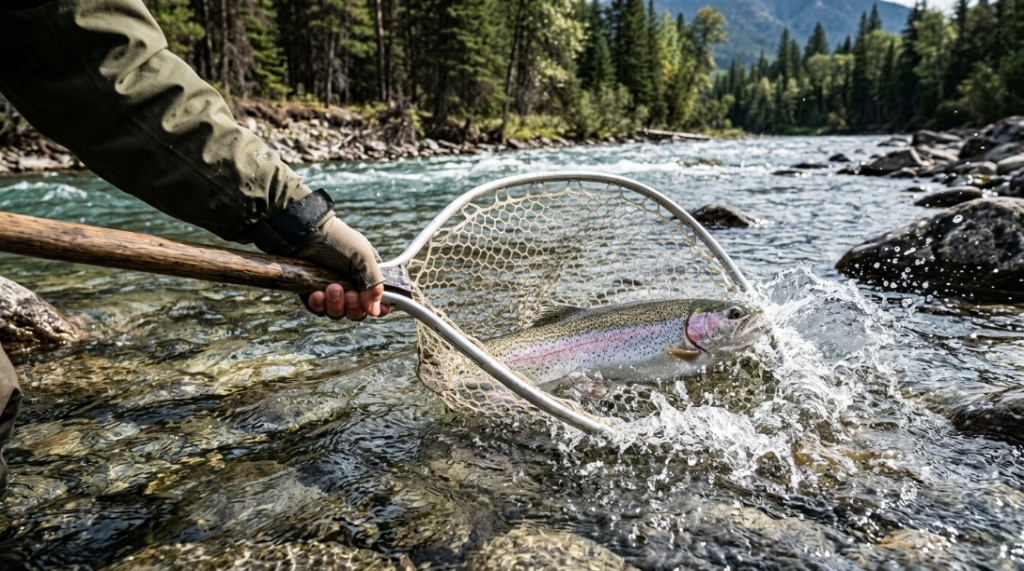
How Do You Choose the Right Net Size?
Choose a net hoop at least 50% wider than the longest fish you expect to land. For 20-inch fish, you need at least a 30-inch hoop. Undersizing is the #1 net mistake — it’s always better to have more room than you need.
Size selection by target species:
| Target Fish Length | Minimum Hoop Width | Recommended Net Depth | Common Species |
|---|---|---|---|
| 10–14 inches | 18–20 inches | 12–18 inches | Panfish, trout (stocked) |
| 14–20 inches | 22–26 inches | 18–24 inches | Bass, walleye, average trout |
| 20–30 inches | 28–34 inches | 24–30 inches | Large bass, pike, steelhead |
| 30+ inches | 36+ inches | 30–36 inches | Musky, large pike, salmon |
The oversizing principle: you can always land a small fish in a large net, but you can’t land a large fish in a small net. When in doubt, go one size up. A larger net rarely hurts, while an undersized net regularly costs fish. Match the net to your largest realistic target, not your average catch.
Why Does Mesh Type Matter So Much?
Mesh type determines whether hooks tangle (wasting time and losing fish), whether fish are harmed (slime removal, fin damage), and how easily you can unhook fish — making it arguably the most important net choice after size.
Mesh types compared:
- Rubber/silicone mesh (best overall): Doesn’t tangle hooks, protects fish slime coating, allows easy release. Slightly heavier and more expensive. The modern standard for catch-and-release.
- Knotless nylon mesh (good): Less tangling than knotted, gentler on fish than knotted nylon. More affordable than rubber. Adequate for many anglers.
- Knotted nylon mesh (avoid for C&R): Tangles hooks badly, removes fish slime, damages fins. Cheap but problematic. Acceptable only for fish you’re keeping.
- Coated/treated mesh: Nylon with coating to reduce tangling and fish harm. Middle ground between rubber and standard nylon.
For catch-and-release anglers (the majority in many fisheries), rubber mesh is the clear winner — hooks pop out easily, fish slime stays intact, and fin damage is minimized. The slightly higher cost pays off in both fish welfare and fishing convenience. Avoid knotted nylon unless you’re keeping every fish you catch.
How Long Should Your Net Handle Be?
Handle length should match your fishing position: 18–24 inches for wading, 3–6 feet for shore or bank fishing, and 4–8 feet for boat fishing. A handle too short forces dangerous reaching; too long becomes unwieldy.
Handle length by fishing style:
- Wading/stream fishing (18–24 inches): Short handle for portability and close-range netting. Fish are usually right in front of you. Long handles are cumbersome while wading.
- Shore/bank fishing (3–6 feet): Moderate handle reaches fish from elevated banks or shorelines without dangerous leaning.
- Boat fishing — small boats (4–6 feet): Reaches over the gunwale to fish beside the boat without excessive reach.
- Boat fishing — larger boats (6–8+ feet): Extra reach for higher decks and fish that stay away from the hull.
- Telescoping handles (versatile): Extend when needed, collapse for storage. Ideal for mixed situations or limited storage space.
The critical mistake: buying a short-handle net for boat fishing or a long-handle net for wading. Match the handle to where you fish, or choose a telescoping handle that adapts to multiple scenarios.
Selecting the right net is just the first step in optimizing your gear setup; matching your landing tools with the right attractors is what actually brings the fish to the surface. For instance, if you are planning a trip to a premier global angling destination, you might wonder, what is destination travel in the world of sport fishing without the right tackle? To maximize your chances of success in those legendary coastal waters, pairing your new net with high-performing gear like Artificial Shrimp Lures for Saltwater Fishing Success will ensure you aren’t just holding the perfect net, but actually filling it.
What Construction Features Indicate a Quality Net?
Quality nets have reinforced hoop-to-handle junctions, corrosion-resistant hardware, rigid yet lightweight hoop material (aluminum or carbon fiber), and secure mesh attachment — the points where cheap nets fail under stress.
Quality indicators:
- Hoop-to-handle junction: The #1 failure point. Should be reinforced, solid, and not wobbly. Cheap nets flex or break here under fish weight.
- Handle material: Aluminum (lightweight, corrosion-resistant), carbon fiber (lightest, strong), or quality fiberglass (affordable, durable). Avoid flimsy wood or thin plastic.
- Hoop material: Aluminum or carbon fiber maintains shape under stress. Cheap wire hoops deform permanently.
- Hardware: Stainless or coated hardware resists corrosion. Cheap hardware rusts and weakens.
- Mesh attachment: Securely fastened to the hoop — not loosely tied or stapled.
- Overall rigidity: The loaded net should maintain shape and control. Excessive flex makes landing unpredictable.
Should You Buy a Folding or Fixed Net?
Folding nets are best for portability and storage (kayaks, wading, backpacking), while fixed nets are stronger and more rigid, making them better for large fish and boat-based fishing where storage isn’t a constraint.
Folding vs. fixed comparison:
- Folding nets: Compact storage, easy to carry while wading or hiking. Hoop folds for transport. Tradeoff: slightly less rigid than fixed, more potential failure points at hinges.
- Fixed nets: Maximum rigidity and strength. No hinges to fail. Best for landing larger fish. Tradeoff: bulky to store and transport.
- Telescoping handle + fixed hoop: Good compromise — handle collapses for storage while the hoop remains rigid.
Choose folding if portability matters (wading, kayak, hiking to remote spots). Choose fixed if strength matters (large fish, boat fishing with storage room). Quality folding nets from good brands are plenty strong for most fish — they’re not inherently weaker, just slightly less rigid at the fold point.
How Does Price Relate to Quality in Fishing Nets?
Budget $30–$80 for a quality fishing net. Below $20, expect poor construction, tangling mesh, and weak handles. Above $100, you’re paying for premium materials (carbon fiber) that deliver marginal improvement for most anglers.
Price tier guide:
- Under $20: Poor quality risk. Knotted nylon, weak handles, small hoops, corroding hardware. False economy that fails when you need it.
- $30–$60 (sweet spot): Quality rubber or knotless mesh, aluminum/fiberglass construction, adequate size options. Best value for most anglers.
- $60–$100: Premium mesh, better handle materials, larger sizes, improved ergonomics. Worth it for serious anglers and larger species.
- $100+: Carbon fiber, handcrafted, ultralight. For dedicated anglers who value the lightest and best. Diminishing returns for casual fishing.
What Net Mistakes Are Specific to Certain Fishing Types?
Fly anglers need shallow, fish-friendly nets with short handles; bass anglers need wide hoops with deep bags; kayak anglers need compact, one-hand-operable nets; and ice anglers need nets that fit through holes — each type has specific requirements most generic nets don’t meet.
Type-specific mistakes to avoid:
- Fly fishing: Don’t buy deep-bagged nets that tangle fly hooks. Choose shallow rubber mesh with short handles for stream wading.
- Bass fishing from boat: Don’t buy small trout nets. Need wide hoops (24″+) and deep bags for active bass that thrash.
- Kayak fishing: Don’t buy long-handled nets. Need compact, one-hand-operable nets that stow on deck.
- Ice fishing: Don’t buy standard nets. Need nets that fit through your ice hole (usually 8–10 inches).
- Musky/pike: Don’t buy average-size nets. Need 36″+ hoops and deep bags for these large, powerful fish.
Conclusion
Avoiding the wrong fishing net comes down to matching size, mesh type, handle length, and construction to your actual fishing — not buying based on price alone or grabbing whatever’s available. Size the hoop 50% wider than your largest target fish, choose rubber mesh for catch-and-release fishing, match handle length to your fishing position, and invest in quality construction at the hoop-handle junction where cheap nets fail.
Budget $30–$80 for a net that performs reliably for years, and resist both the temptation of bargain-bin nets that cost fish and the allure of premium nets with marginal benefits for your fishing. The net is the last tool between you and a landed fish — it deserves the same thoughtful selection as your rod, reel, and lures. Choose once, choose right, and every fish that reaches your net actually makes it into your hands.
What species do you target and where do you fish from? Share in the comments — I’ll recommend the specific net size, mesh type, and handle length for your fishing.
Frequently Asked Questions
What size fishing net do I need?
Choose a net hoop at least 50% wider than the longest fish you expect to land. For 20-inch fish, you need at least a 30-inch hoop. When in doubt, go one size up — a larger net rarely hurts, while an undersized net regularly costs fish at the moment of landing.
What mesh type is best for fishing nets?
Rubber or silicone mesh is best overall — it doesn’t tangle hooks, protects fish slime coating, and allows easy release. Knotless nylon is a good budget alternative. Avoid knotted nylon, which tangles hooks badly and damages fish through slime removal and fin abrasion.
How long should a fishing net handle be?
18–24 inches for wading, 3–6 feet for shore/bank fishing, and 4–8 feet for boat fishing. Match handle length to your fishing position. Telescoping handles offer versatility for mixed situations. A handle too short forces dangerous reaching; too long becomes unwieldy.
How much should I spend on a fishing net?
Budget $30–$80 for a quality fishing net with rubber mesh and reliable construction. Below $20, expect poor mesh, weak handles, and corroding hardware. Above $100, you’re paying for premium materials that deliver marginal improvement for most anglers. The $30–$60 range offers the best value.
Are rubber mesh nets better than nylon?
Yes, for most anglers. Rubber mesh doesn’t tangle hooks (faster unhooking), protects fish slime (better for catch-and-release), and prevents fin damage. It costs slightly more and is slightly heavier than nylon, but the convenience and fish-welfare benefits make it the modern standard.
Why do I keep losing fish at the net?
Common causes: net too small (chasing instead of guiding), mesh tangling hooks (fish escapes during struggle), net depth too shallow (fish swims back out), and poor netting technique (swiping instead of guiding headfirst). A properly sized net with rubber mesh solves the gear-related issues.
Should I buy a folding or fixed fishing net?
Choose folding if portability matters (wading, kayak, hiking). Choose fixed if strength matters most (large fish, boat fishing with storage). Quality folding nets are plenty strong for most fish — they’re not inherently weaker, just slightly less rigid at the fold point.
Sorry, the comment form is closed at this time.