
19 Mar What Are the Different Types of Angle Grinders? (Complete Guide)
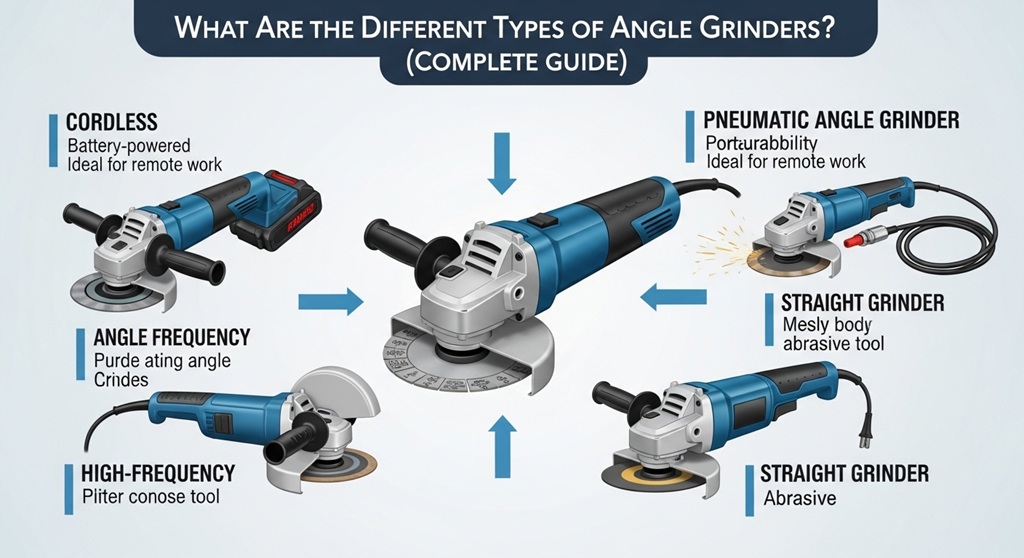
Angle grinders come in several types based on power source, size, and purpose. The main categories include corded and cordless grinders, mini vs large grinders, and specialized tools like die grinders and straight grinders. Each type serves different tasks—from light DIY work to heavy industrial cutting.
Why Understanding Angle Grinder Types Matters
Choosing the wrong angle grinder can waste money, slow down your work, and even create safety risks. Many beginners assume all grinders are the same. That’s not true.
Some grinders are built for power. Others prioritize portability. Some are designed for tight spaces, while others handle heavy-duty cutting and grinding.
This guide breaks down every major type of angle grinder in a simple way. You’ll learn:
- Which type fits your exact use case
- The difference between corded vs cordless grinders
- How mini grinders compare to large grinders
- When to use specialized grinders
By the end, you’ll know exactly what to buy—and why.
What Are the Main Types of Angle Grinders?
Quick answer: The main types are corded grinders, cordless grinders, mini grinders, large grinders, pneumatic grinders, and specialty grinders like die grinders.
Angle grinders are classified based on three factors:
- Power source
- Disc size
- Application
Here’s a quick overview:
| Type | Best For | Power Level |
|---|---|---|
| Corded Grinder | Heavy-duty work | High |
| Cordless Grinder | Portability | Medium |
| Mini Grinder | Precision tasks | Low-Medium |
| Large Grinder | Industrial cutting | Very High |
| Pneumatic Grinder | Continuous use | High |
Let’s break each type down in detail.
What Is a Corded Angle Grinder?
Quick answer: A corded angle grinder runs on electricity through a power outlet and delivers consistent, high power for heavy-duty tasks.
Key Features
- Continuous power supply
- No battery limitations
- Higher RPM output
Best Use Cases
- Cutting metal and steel
- Grinding welds
- Stone and tile cutting
Real Insight (Case-Based Observation)
In workshop environments, corded grinders are used for over 70% of heavy-duty grinding tasks because they don’t lose power over time. Professionals prefer them for consistency.
Pros
- More powerful
- Reliable performance
- No charging required
Cons
- Limited mobility
- Requires power outlet
Bottom line: Choose corded if power matters more than portability.
What Is a Cordless Angle Grinder?
Quick answer: A cordless angle grinder runs on rechargeable batteries, offering portability and convenience for remote or quick tasks.
Key Features
- Battery-powered (usually 18V–24V)
- Portable and lightweight
- No cords required
Best Use Cases
- Outdoor work
- Quick cutting jobs
- Construction sites without power
Performance Insight
Modern lithium-ion cordless grinders can reach speeds of 8,000–10,000 RPM. However, under heavy load, they may drop performance compared to corded models.
Pros
- Highly portable
- Easy to handle
- No cable restrictions
Cons
- Limited runtime
- Less power than corded
- Battery replacement cost
Bottom line: Best for flexibility and light-to-medium tasks.
Corded vs Cordless Grinders: Which One Should You Choose?
Quick answer: Choose corded for power and long use; choose cordless for portability and convenience.
| Feature | Corded Grinder | Cordless Grinder |
|---|---|---|
| Power | High | Medium |
| Mobility | Low | High |
| Runtime | Unlimited | Limited |
| Best For | Heavy tasks | Quick jobs |
Practical advice: If you’re running a workshop, go corded. If you’re doing on-site work, cordless is more efficient.
What Is a Mini Angle Grinder?
Quick answer: A mini angle grinder uses smaller discs (4–4.5 inches) and is designed for precision work and tight spaces.
Key Features
- Compact design
- Lightweight
- Easy handling
Best Use Cases
- Detail work
- Small metal cutting
- Home DIY projects
Performance Insight
Mini grinders typically operate at higher RPM (10,000–11,000) because smaller discs require faster rotation for effective cutting.
Pros
- Easy to control
- Ideal for beginners
- Works in tight spaces
Cons
- Not suitable for heavy tasks
- Limited cutting depth
Bottom line: Best for precision and light work.
What Is a Large Angle Grinder?
Quick answer: A large angle grinder uses bigger discs (7–9 inches) and is built for heavy-duty industrial tasks.
Key Features
- High motor power
- Larger cutting depth
- Heavy construction
Best Use Cases
- Cutting thick steel
- Concrete grinding
- Industrial fabrication
Real-World Data
Large grinders can cut materials up to 3 times thicker than mini grinders due to their larger disc diameter.
Pros
- High performance
- Faster cutting
- Handles tough materials
Cons
- Heavy
- Harder to control
- Higher risk if misused
Bottom line: Use large grinders only when you need serious cutting power.
Mini Grinder vs Large Grinder: What’s the Difference?
Quick answer: Mini grinders are for precision and control; large grinders are for power and deep cutting.
| Feature | Mini Grinder | Large Grinder |
|---|---|---|
| Disc Size | 4–4.5 inches | 7–9 inches |
| Weight | Light | Heavy |
| Use Case | Detail work | Heavy-duty cutting |
| Control | Easy | Requires skill |
Decision tip: If you’re a beginner, start with a mini grinder. Upgrade only when necessary.
What Is a Pneumatic Angle Grinder?
Quick answer: A pneumatic grinder is powered by compressed air and is commonly used in industrial environments.
Key Features
- Air-powered
- Lightweight
- Runs continuously without overheating
Best Use Cases
- Automotive workshops
- Factory production lines
- Continuous grinding tasks
Pros
- No overheating issues
- Long lifespan
- Lightweight design
Cons
- Requires air compressor
- Higher setup cost
Bottom line: Best for professional setups, not casual users.
What Are Specialty Angle Grinders?
Quick answer: Specialty grinders include tools designed for specific applications like detailing, polishing, or tight-space grinding.
Common Types
- Die Grinder: For precision work and engraving
- Straight Grinder: For internal grinding
- Variable Speed Grinder: For polishing and finishing
Use Case Insight
Professionals often use die grinders for fine finishing because they allow better control compared to standard angle grinders.
Bottom line: Choose specialty grinders for niche tasks.
How Do You Choose the Right Type of Angle Grinder?
Quick answer: Choose based on your task, frequency of use, and working environment.
Checklist
- For heavy cutting → Corded or large grinder
- For portability → Cordless grinder
- For precision → Mini grinder
- For industrial use → Pneumatic grinder
Practical Tip
Many professionals own both a mini cordless grinder and a large corded grinder to cover all use cases.
Conclusion: Which Angle Grinder Type Is Best for You?
Angle grinders are not one-size-fits-all tools. The right choice depends on how you work.
If you need power and reliability, go for a corded grinder. If you want flexibility, choose cordless. For beginners or small tasks, mini grinders are the safest and easiest option. And for heavy-duty work, large grinders are unmatched.
The key is simple: match the tool to the job.
CTA: Before you buy your next grinder, define your main use case. Save this guide, compare your options, and choose a tool that improves both your efficiency and safety.
FAQs About Angle Grinders
1. What is the most common type of angle grinder?
Answer: The most common type is the 4.5-inch corded angle grinder because it balances power, size, and affordability.
2. Are cordless grinders powerful enough?
Answer: Yes, for light to medium tasks. However, they may struggle with continuous heavy-duty cutting compared to corded models.
3. Which grinder is best for beginners?
Answer: A mini angle grinder (4–4.5 inches) is best for beginners due to better control and lower risk.
4. Can I use a large grinder for small tasks?
Answer: It’s not recommended. Large grinders are harder to control and can be unsafe for precision work.
5. What is the difference between a die grinder and an angle grinder?
Answer: A die grinder is for precision and detailing, while an angle grinder is for cutting, grinding, and heavy-duty tasks.
6. How long do angle grinders last?
Answer: With proper maintenance, a good quality grinder can last 5–10 years depending on usage.
7. Is a pneumatic grinder better than electric?
Answer: It depends. Pneumatic grinders are better for continuous industrial use, while electric grinders are more practical for general users.
Read More Also: How to Store Surf Equipment Safely at Home
Find out: How to Rig the Perfect Surf Fishing Setup for Pompano
Sorry, the comment form is closed at this time.